As You Like It: Act 1, Scene 2
Enter CELIA and ROSALIND.
CELIA
1. sweet my coz: my dear cousin. —"Coz," short for "cousin," is an endearment, but Celia and Rosalind are actual cousins.
1 I pray thee, Rosalind, sweet my coz, be 2 merry.
ROSALIND
3-4. I show more mirth than I am / mistress of: i.e., I am (already) acting happier than I actually feel. 6. learn: teach.
3 Dear Celia, I show more mirth than I am 4 mistress of; and would you yet I were merrier? 5 Unless you could teach me to forget a banished 
Lilian Wouters as Celia; Maryssa Wanlass as Rosalind.
6 father, you must not learn me how to remember 7 any extraordinary pleasure.
CELIA
8 Herein I see thou lovest me not with the full 9 weight that I love thee. If my uncle, thy banished 10 father, had banished thy uncle, the duke my11. so thou hadst been still with me: provided that you had always stayed by my side.
11 father, so thou hadst been still with me, I could 12 have taught my love to take thy father for mine:13-14. if the truth of thy love to me were so righteously temper'd as mine is to thee: if the real essence of your love for me were as rightly balanced as my love for you.
13 so wouldst thou, if the truth of thy love to me 14 were so righteously temper'd as mine is to thee.
ROSALIND
15. condition of my estate: circumstances of my situation. —Rosalind's current situation is very uncomfortable. At Celia's request Rosalind has remained in the court of Celia's father (Duke Frederick) who has betrayed his brother (Rosalind's father), taken his ducal throne and sent him into exile. Rosalind and Celia love one another, but soon Celia's father's nasty temper will send them both into exile.
15 Well, I will forget the condition of my estate, 16 to rejoice in yours.
CELIA
17 You know my father hath no child but I, nor 18 none is like to have: and, truly, when he dies, 19 thou shalt be his heir, for what he hath taken 20. perforce: by force.
20 away from thy father perforce, I will render thee 21 again in affection; by mine honour, I will; and 22 when I break that oath, let me turn monster: 23 therefore, my sweet Rose, my dear Rose, be merry.
ROSALIND
24. sports: amusements.
24 From henceforth I will, coz, and devise sports. 25 Let me see; what think you of falling in love?
CELIA
26 Marry, I prithee, do, to make sport withal: but 27 love no man in good earnest; nor no further in 28. safety: safeguard. pure: innocent.
29. come off again: escape.
29. come off again: escape.
28 sport neither than with safety of a pure blush 29 thou mayst in honour come off again.
ROSALIND
30 What shall be our sport, then?
CELIA
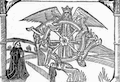 31-33. Let us sit and mock the good huswife Fortune / from her wheel, that her gifts may henceforth be bestowed equally:—In referring to Fortune as a "good huswife," Celia is using a little humorous word-play. Lady Fortune was . . ."
 31 Let us sit and mock the good huswife Fortune 32 from her wheel, that her gifts may henceforth 33 be bestowed equally.
ROSALIND
34 I would we could do so, for her benefits are mightily35. the bountiful blind woman: —Fortune was often depicted wearing a blindfold, to indicate that she gives her gifts at random, without any regard for what people deserve.
35 misplaced, and the bountiful blind woman doth most 36 mistake in her gifts to women.
CELIA
37 'Tis true; for those that she makes fair she scarce38. honest: chaste.
38 makes honest, and those that she makes honest she39. ill-favoredly: ugly.
39 makes very ill-favouredly.
ROSALIND
40. office: function.
40 Nay, now thou goest from Fortune's office to41. gifts of the world: i.e., wealth, power, and other gifts granted by one's family and society, as contrasted with beauty, intelligence, and other "lineaments of Nature" that a person is born with.
41 Nature's: Fortune reigns in gifts of the world, 42 not in the lineaments of Nature.
Enter Clown [Touchstone].
CELIA
43 No? when Nature hath made a fair creature, 44 may she not by Fortune fall into the fire? 45. flout: mock, jeer.
45 Though Nature hath given us wit to flout at 46 Fortune, hath not Fortune sent in this fool47. cut off the argument: end the discussion.
47 to cut off the argument?
ROSALIND
48 Indeed, there is Fortune too hard for Nature, 49. Nature's natural: idiot, simpleton. —Touchstone is a professional jester, and such clowns or fools were conventionally considered to be mentally challenged, so that nothing they said could be considered deliberately insulting. However, all of the fools who appear in Shakespeare's plays, including Touchstone, are extremely intelligent and make insightful remarks in a supposedly foolish way.
49 when Fortune makes Nature's natural the 50 cutter-off of Nature's wit.
CELIA
51 Peradventure this is not Fortune's work neither, 52 but Nature's; who perceiveth our natural wits 53 too dull to reason of such goddesses and hath 54 sent this natural for our whetstone; for always 55 the dulness of the fool is the whetstone of the 56. How now, wit! whither wander you?:
Celia is addressing Touchstone as "wit," but also making a comment about herself. "How now, wit! wither wander you?" is a saying that was used when someone talked on and on and wandered away from the point.
56 wits. How now, wit! whither wander you?
TOUCHSTONE
57 Mistress, you must come away to your 58 father.
CELIA
59 Were you made the messenger?
TOUCHSTONE
60 No, by mine honour, but I was bid to come 61 for you. ROSALIND
62 Where learned you that oath, fool?
TOUCHSTONE
63 Of a certain knight that swore by his honour they 64 were good pancakes and swore by his honour the65. naught: worthless, bad.
65 mustard was naught: now I'll stand to it, the 66 pancakes were naught and the mustard was good,67. forsworn: perjured.
67 and yet was not the knight forsworn.
CELIA
68 How prove you that, in the great heap of your 69 knowledge?
ROSALIND
70 Ay, marry, now unmuzzle your wisdom.
TOUCHSTONE
71 Stand you both forth now: stroke your 72 chins, and swear by your beards that I 73 am a knave.
CELIA
74 By our beards, if we had them, thou art.
TOUCHSTONE
75 By my knavery, if I had it, then I were; but 76 if you swear by that that is not, you are not 77 forsworn: no more was this knight swearing 78 by his honour, for he never had any; or if he 79 had, he had sworn it away before ever he saw 80 those pancakes or that mustard.
CELIA
81 Prithee, who is't that thou meanest?
TOUCHSTONE
82 One that old Frederick, your father, loves.
CELIA
83 My father's love is enough to honour him 84 enough. Speak no more of him; you'll be 85. taxation: making critical or satirical comments, such as the one about the knight's lack of honor.
85 whipped for taxation one of these days.
TOUCHSTONE
86-87. The more pity, that fools may not speak / wisely what wise men do foolishly: it's a pity that fools may not wisely point out the foolish things done by (supposedly) wise men.
86 The more pity, that fools may not speak 87 wisely what wise men do foolishly.
CELIA
88. my troth: my faith.
88 By my troth, thou sayest true; for since 89 the little wit that fools have was silenced, 90 the little foolery that wise men have makes 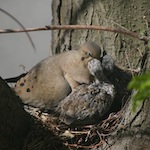
91 a great show. Here comes Monsieur Le Beau.
Enter Le Beau.
ROSALIND 92 With his mouth full of news.
CELIA
93-94. put on us: force on us. as pigeons feed / their young: When pigeons feed their young, it appears that the adults are forcing food down the throats of the chicks, although it's really the other way around: pigeons produce a kind of slurry in their crops, and their chicks dive in to eat.
93 Which he will put on us, as pigeons feed 94 their young.
ROSALIND
95 Then shall we be news-cramm'd.
CELIA
96-97. more marketable: —Fowl fattened by forced feeding were more marketable. Forced feeding of ducks and geese is still used in the production of foie gras. (See the Wikipedia article, "Foie gras controversy.")
96 All the better; we shall be the more 97 marketable. Bon jour, Monsieur 98 Le Beau. What's the news?
LE BEAU
99. you have lost: you have missed out on.
99 Fair princess, you have lost much good 100 sport.
CELIA
101. of what colour?: of what kind?
101 Sport! of what colour?
LE BEAU
102 What colour, madam! how shall I answer103 you?
ROSALIND
104 As wit and fortune will.
TOUCHSTONE
105 Or as the Destinies decrees.
CELIA
106. that was laid on with a trowel: i.e., your witticism was clumsy.
106 Well said — that was laid on with a trowel.
TOUCHSTONE
107. rank: i.e., status as a professional wit. —Apparently, Touchstone is trying to defend himself against Celia's comment on the lameness of his previous witticism when Rosalind interrupts him with a pun on the sense of "rank" as "bad-smelling." All three wits, Touchstone and the two ladies, are having a fine time shooting zingers at one another.
107 Nay, if I keep not my rank,—
ROSALIND
108 Thou losest thy old smell.
LE BEAU
109. amaze: bewilder.
109 You amaze me, ladies: I would have told 110 you of good wrestling, which you have111 lost the sight of.
ROSALIND
112 You tell us the manner of the wrestling.
LE BEAU
113 I will tell you the beginning; and, if it please 114 your ladyships, you may see the end; for 115. yet to do: yet to be done.
115 the best is yet to do; and here, where you are, 116 they are coming to perform it.
CELIA
117 Well, the beginning, that is dead and buried.
LE BEAU
118 There comes an old man and his three sons,—
CELIA
119-120. I could match this beginning with an old / tale.: i.e., that isn't a very original beginning. —A lot of folk tales tell a story of a father with three sons.
119 I could match this beginning with an old120 tale.
LE BEAU
121. proper: handsome.
121 Three proper young men, of excellent growth 122 and presence.
ROSALIND
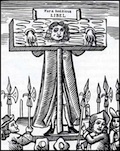 123-124. With bills on their necks, 'Be it known unto / all men by these presents': —A bill is a placard, and the phrase, 'Be it known unto all men by these presents' was often used in legal documents, meaning "be it known unto all men by this document." Rosalind is punning . . . 128. that: so that.
 123 With bills on their necks, 'Be it known unto 124 all men by these presents.'
LE BEAU
125 The eldest of the three wrestled with Charles, 126 the duke's wrestler; which Charles in a 127 moment threw him and broke three of his ribs, 128 that there is little hope of life in him: so he 129 served the second, and so the third. Yonder they 130 lie; the poor old man, their father, making such131. dole: lamentation.
131 pitiful dole over them that all the beholders132 take his part with weeping.
ROSALIND
133 Alas!
TOUCHSTONE
134 But what is the sport, monsieur, that the 135 ladies have lost?
LE BEAU
136 Why, this that I speak of.
TOUCHSTONE
137 Thus men may grow wiser every day: 138 it is the first time that ever I heard breaking 139 of ribs was sport for ladies.
CELIA
140 Or I, I promise thee.
ROSALIND
141-142. this broken music / in his sides: —"Broken music" is music arranged for a combination of different kinds of instruments, but of course Rosalind is being sarcastic; she doesn't think that the gasps of a man with broken ribs would be very musical at all.
141 But is there any else longs to see this broken music142 in his sides? is there yet another dotes upon143 rib-breaking? Shall we see this wrestling, cousin?
LE BEAU
144 You must, if you stay here; for here is the place145 appointed for the wrestling, and they are ready to146 perform it.
CELIA
147 Yonder, sure, they are coming: let us now stay148 and see it.
Flourish: trumpet fanfare (announcing the appearance of Duke Frederick).
Flourish. Enter DUKE FREDERICK, Lords, ORLANDO, CHARLES, and Attendants. DUKE FREDERICK
149-150. since the youth will not be entreated, / his own peril on his forwardness: i.e., since the young man refuses to heed entreaties, the danger he's running into is due to his own heedless eagerness. —As we quickly learn, Duke Frederick is speaking of Orlando, who insists on wrestling the fearsome Charles.
149 Come on: since the youth will not be entreated, 150 his own peril on his forwardness.
ROSALIND
151 Is yonder the man?
LE BEAU
152 Even he, madam.
CELIA
153 Alas, he is too young! yet he looks154 successfully.
DUKE FREDERICK
155 How now, daughter and cousin! are 156 you crept hither to see the wrestling?
ROSALIND
157. liege: sovereign.
157 Ay, my liege, so please you give us leave.
DUKE FREDERICK
158 You will take little delight in it, I can tell 159. there is such odds in the man: i.e., Charles is obviously the better man. 160. fain: gladly.
159 you; there is such odds in the man. In pity 160 of the challenger's youth I would fain 161 dissuade him, but he will not be entreated. 162 Speak to him, ladies; see if you can move him.
CELIA
163 Call him hither, good Monsieur Le Beau.
DUKE FREDERICK
164 Do so: I'll not be by.
LE BEAU
165 Monsieur the challenger, the princesses166 call for you.
ORLANDO
167 I attend them with all respect and duty.
ROSALIND
168 Young man, have you challenged Charles169 the wrestler?
ORLANDO
170 No, fair princess; he is the general challenger: 171 I come but in, as others do, to try with him the172 strength of my youth.
CELIA
173 Young gentleman, your spirits are too bold for your174 years. You have seen cruel proof of this man's175 strength: if you saw yourself with your eyes or176-177. fear: fearsomeness, danger. your adventure: your venture, the risk you are taking. 177-178. would counsel you to a more equal / enterprise: i.e., would strongly advise you to attempt an enterprise that is more equal to your abilities.
176 knew yourself with your judgment, the fear of your177 adventure would counsel you to a more equal178 enterprise. We pray you, for your own sake, to179 embrace your own safety and give over this attempt.
ROSALIND
180 Do, young sir; your reputation shall not therefore181. mispris'd: despised.
181 be misprised: we will make it our suit to the duke182 that the wrestling might not go forward.
ORLANDO
183-185. punish me . . . ladies anything: i.e., don't think badly of me, even though I confess I am guilty of the sin of denying any request from so fair and excellent ladies as yourselves.
186-187. my / trial: i.e. the trial of my strength, skill, and courage (in wrestling Charles).
183 I beseech you, punish me not with your hard184 thoughts, wherein I confess me much guilty, to deny185 so fair and excellent ladies anything. But let186 your fair eyes and gentle wishes go with me to my187 trial: wherein if I be foiled, there is but one188. gracious: in favor, esteemed.
188 shamed that was never gracious; if killed, but one189 dead that was willing to be so: I shall do my190 friends no wrong, for I have none to lament me, the191 world no injury, for in it I have nothing; only in192 the world I fill up a place, which may be better193 supplied when I have made it empty.
ROSALIND
194 The little strength that I have, I would it were195 with you.
CELIA
196. eke out: add to.
196 And mine, to eke out hers.
ROSALIND
197-198. deceived in / you: i.e., mistaken about your chances.
197 Fare you well: pray heaven I be deceived in198 you!
CELIA
199 Your heart's desires be with you!
CHARLES
200 Come, where is this young gallant that is 201 so desirous to lie with his mother earth?
ORLANDO
202-203. Ready, sir; but his will hath in it a more / modest working: i.e., I want something a little less than the glory of death. —Charles the wrestler has just boastfully asked "where is this young gallant that is so desirous to lie with his mother earth?" I believe that Orlando responds to Charles' boastfulness with modest irony. However, other editors assert that Orlando takes Charles' phrase "lie with" in the sense of "to have sex with," and that therefore he uses "modest" in a sexual sense. If this is true, Orlando has twisted Charles' words about in order to make a coarse sex joke, but I don't believe that this sort of sexual humor fits well with Orlando's general character.
202 Ready, sir; but his will hath in it a more203 modest working.
DUKE FREDERICK
204 You shall try but one fall.
CHARLES
205 No, I warrant your grace, you shall not 206 entreat him to a second, that have so 207 mightily persuaded him from a first.
ORLANDO
208 An you mean to mock me after, you should not 209. come your ways: — This is a common phrase meaning something like "let's see what you've got," or "stop talking and start doing."
209 have mock'd me before: but come your ways.
ROSALIND
210. Now Hercules be thy speed, young man! : May Hercules aid you and give you success, young man! —Hercules was mythological hero of super-human strength.
210 Now Hercules be thy speed, young man!
CELIA
211 I would I were invisible, to catch the strong212 fellow by the leg.
Wrestle.
ROSALIND
213 O excellent young man!
CELIA
214 If I had a thunderbolt in mine eye, I can 215 tell who should down.
Shout. [Orlando throws Charles.]
DUKE FREDERICK
216 No more, no more.
ORLANDO
217-218. I am not yet / well breathed: i.e., I'm not even warmed up.
217 Yes, I beseech your grace: I am not yet 218 well breathed.
DUKE FREDERICK
219 How dost thou, Charles?
LE BEAU
220 He cannot speak, my lord.
DUKE FREDERICK
221 Bear him away. What is thy name, young man?
ORLANDO
222 Orlando, my liege; the youngest son of223 Sir Rowland de Boys.
DUKE FREDERICK
224 I would thou hadst been son to some man else:225 The world esteem'd thy father honourable,226. still: always.
226 But I did find him still mine enemy:227 Thou shouldst have better pleased me with this deed,228 Hadst thou descended from another house.229 But fare thee well; thou art a gallant youth:230 I would thou hadst told me of another father.
Exit DUKE [FREDERICK, train, and LE BEAU].
CELIA
231. do this: behave thus. —This is a rhetorical question. Celia means that she would never act in the churlish way that her father just has.
231 Were I my father, coz, would I do this?
ORLANDO
232 I am more proud to be Sir Rowland's son,233. calling: name.
233 His youngest son; and would not change that calling,234 To be adopted heir to Frederick.
ROSALIND
235 My father loved Sir Rowland as his soul,236 And all the world was of my father's mind:237. Had I before known this young man his son: Had I known before that this young man was his son. 238. unto: in addition to. 239. Ere he should thus have ventured: i.e., in order to keep him from making the decision to take the dangerous chances that he took in wrestling Charles.
237 Had I before known this young man his son,238 I should have given him tears unto entreaties,239 Ere he should thus have ventured.
CELIA
239 Gentle cousin,240 Let us go thank him and encourage him:241. envious: —In this play and many others, Shakespeare presents envy as the source of great evil . . . 242. Sticks me at heart: stabs me in the heart. 243-245. If you do keep your promises in love / But justly, as you have exceeded all promise, / Your mistress shall be happy: i.e. If you keep your love promises as well as you have exceeded all expectations (in the wrestling match), the lady you love will be lucky and happy.
241 My father's rough and envious disposition242 Sticks me at heart. Sir, you have well deserved:243 If you do keep your promises in love244 But justly, as you have exceeded all promise,245 Your mistress shall be happy.
ROSALIND
245 Gentleman,
[Giving him her necklace.]
246. one out of suits with Fortune: one out of favor with Fortune. 247. That could give more, but that her hand lacks means: i.e., would wish to give something of more value, but she has nothing else to give.
246 Wear this for me, one out of suits with Fortune,247 That could give more, but that her hand lacks means.248 Shall we go, coz?
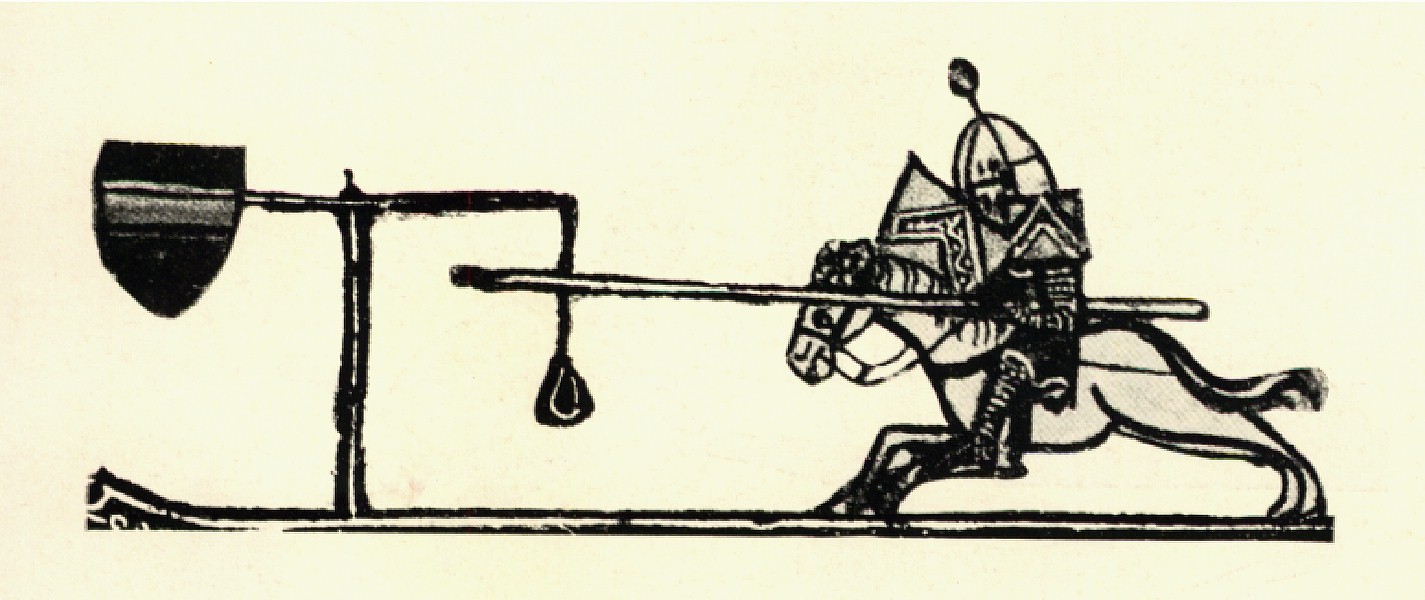 |
| Source: Elizabethan Sports |
CELIA
248 Ay. Fare you well, fair gentleman.
ORLANDO
249 Can I not say, "I thank you"? My better parts250 Are all thrown down, and that which here stands up251 Is but a quintain, a mere lifeless block.
ROSALIND
252 He calls us back: my pride fell with my fortunes;253 I'll ask him what he would. Did you call, sir?254-255. overthrown / More than your enemies: i.e., conquered someone else besides Charles. —Rosalind means her smitten self.
254 Sir, you have wrestled well and overthrown255 More than your enemies.
CELIA
255 Will you go, coz?
ROSALIND
256. Have with you: i.e., yes, I'm coming with you. —The scene is funnier if Rosalind, despite saying this, lingers for a second or two, hoping that Orlando will respond to her heavy, heavy hints.
256 [To Celia] Have with you. [To Orlando] Fare you well.
Exit [Rosalind with Celia].
ORLANDO
257 What passion hangs these weights upon my tongue?258. urged conference: urgently invited conversation.
258 I cannot speak to her, yet she urged conference.259 O poor Orlando, thou art overthrown!260. Or: either.
260 Or Charles or something weaker masters thee.
Enter LE BEAU.
LE BEAU
261 Good sir, I do in friendship counsel you262 To leave this place. Albeit you have deserved263 High commendation, true applause and love,264. condition: mental condition; state of mind.
264 Yet such is now the duke's condition265 That he misconstrues all that you have done.266-267. humorous: moody, changeable. what he is indeed, / More suits you to conceive than I to speak of: i.e., what his real state of mind is, is something that you need to understand, but which I shouldn't really talk about. —Le Beau is warning Orlando that Duke Frederick is likely to try to harm him, but Le Beau is also a courtier to Duke Frederick, and feels that he shouldn't say what a nasty man his lord is.
266 The duke is humorous; what he is indeed,267 More suits you to conceive than I to speak of.
ORLANDO
268 I thank you, sir: and, pray you, tell me this:269 Which of the two was daughter of the duke270 That here was at the wrestling?
LE BEAU
271. Neither . . . manners: i.e., Neither one is his daughter, if we judge by how they act. 272. But yet indeed the smaller is his daughter: —The original text reads, "But yet indeed the taller is his daughter," but that contradicts what Rosalind says in the next scene: "I am more than common tall." Therefore "smaller" is often substituted for "taller."
271 Neither his daughter, if we judge by manners;272 But yet indeed the smaller is his daughter273 The other is daughter to the banish'd duke,274 And here detain'd by her usurping uncle,275 To keep his daughter company; whose loves276 Are dearer than the natural bond of sisters.277 But I can tell you that of late this duke278 Hath ta'en displeasure 'gainst his gentle niece,279. argument: reason, grounds.
279 Grounded upon no other argument280 But that the people praise her for her virtues281 And pity her for her good father's sake;282 And, on my life, his malice 'gainst the lady283 Will suddenly break forth. Sir, fare you well:284. in a better world than this: i.e., when things have changed for the better.
284 Hereafter, in a better world than this,285 I shall desire more love and knowledge of you.
ORLANDO
286. I rest much bounden to you: I will always be much indebted to you.
286 I rest much bounden to you: fare you well.
[Exit Le Beau.]
287. Thus must I from the smoke into the smother: i.e., Thus I go out of the frying pan into the fire.
287 Thus must I from the smoke into the smother;288 From tyrant duke unto a tyrant brother:289 But heavenly Rosalind!
Exit.