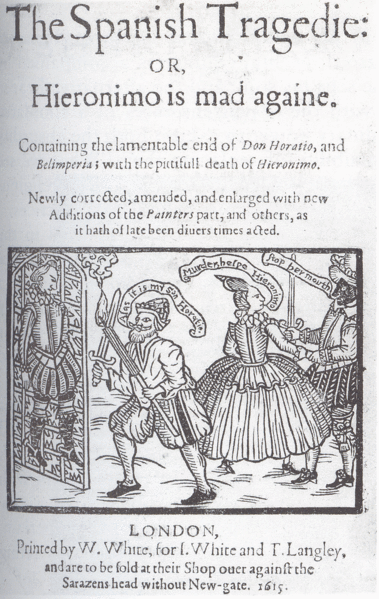
--"the Painters part" featured above the woodcut
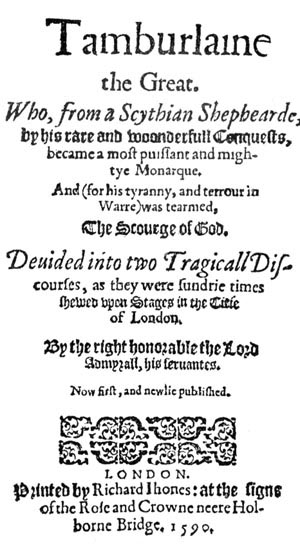
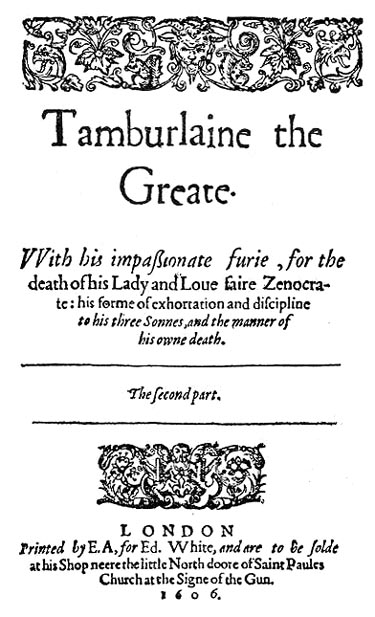
While laying seige to Damascus in Act 5, Tamburlaine looks upon the face of his captive Egyptian princess, Zenocrate, and is suddenly troubled by the otherworldy aspect and power of beauty.
What is Beauty? saith my sufferings then,
If all the pens that poets ever held
Had fed the feeling of their master's thoughts,
And every sweetness that inspired their hearts,
Their minds, and muses on admired themes,
If all the heavenly quintessence they still
From their immortal flowers of Poesy,
Wherein, as in a mirror, we perceive
The highest reaches of a human wit,
If these had made one poem's period
And all combined in Beauty's worthiness,
Yet should there hover in their restless heads
One thought, one grace, one wonder at the least,
Which into words no virtue can digest.
Dr. Faustus:
We often think of old art as being perfect, pure, and remote, but that's not true of Greek statuary (see Ancient Greek Statues Were Once Fruity and Tacky), and it's certainly not true of any drama of Elizabethan times, when a great deal of tacky drama was produced, including some of Shakespeare's stuff.
- In Titus Andronicus . . .
- In Julius Ceasar . . .
- In Romeo and Juliet . . .
- In As You Like It . . .
- In A Winter's Tale . . .
And it's not true for Marlowe's Dr. Faustus, which is the only Marlowe play ever included in a Brit. Lit. anthology, just because it has a few parts which are serious and seriously eloquent, such as,
- "Why this is hell, nor am I out of it . . ." (p.1136, line 76)
- "Was this the face that launched a thousand ships . . ." (p. 1159, line 81)
- "Ah Faustus / Now hast thou but one bare hour to live . . ." (p.1161 line 57)
But the original audience probaly remembered these:
- [Enter like a DEVIL dressed like a woman, with fireworks] — p.1142
- [Enter the SEVEN DEADLY SINS] — p.1145
- [Beat the FRAIRS, and fling fireworks among them, and so Exeunt] — p.1150
- [Enter the KNIGHT with a pair of horns on his head — p.1154
- [Pull him by the leg, and pull it away] — p.1156
To sum up the qualities of Dr. Faustus and much of early drama up to and including Shakespeare's early period: Eloquent, but also Sensationalistic and Melodramatic.