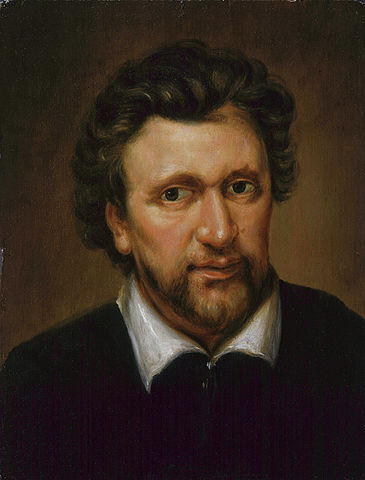
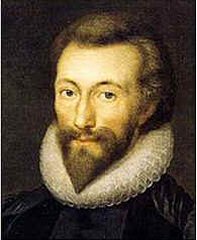
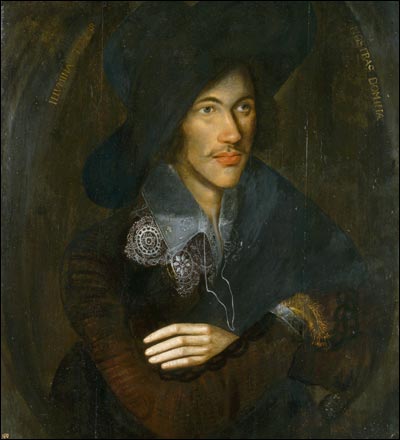
John Donne? >>
| NAVIGATION: | Index of Dr. Weller's Class Materials | Index of English 340 Materials |
A quick look at the cultural revolution mentioned above: The Book of Sports.
Two key figures of the Early Seventeenth Century, Donne and Jonson, were both born in 1572, and so were only 8 years younger than Shakespeare.
| << Ben Jonson John Donne? >> | | |
Cavalier poetry is easy and natural; it uses ideas and figures of speech that are easily understood and have immediate appeal.
Metaphysical poetry is difficult and challenging; it uses ideas and figures of speech that are far-fetched and have to be puzzled out.
Examples of the above: Donne's most famous poem is "A Valediction: Forbidding Mourning" (p. 1385)
Jonson's is "Song: To Celia" (p. 1548)
.
The above is an excerpt from Jonson's The Alchemist. The characters are Jeremy (Captain Face), Dapper, Subtle, and Doll Common.
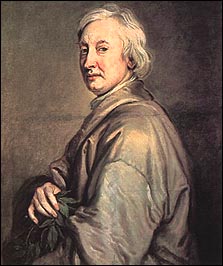
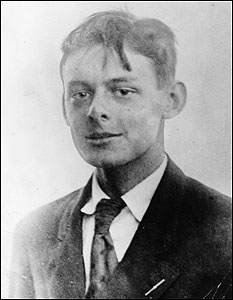 (1888 - 1965), in the 20th Century, as T.S. Eliot found a counterweight to the lushness of neo-romanticism in the intellectualism of Donne.
In his review article, "The Metaphysical Poets" (1921), after comparing Donne and Tennyson, T.S. Eliot wrote:
The difference is not a simple difference of degree between poets. It is something which had happened to the mind of England between the time of Donne or Lord Herbert of Cherbury and the time of Tennyson and Browning; it is the difference between the intellectual poet and the reflective poet. Tennyson and Browning are poets, and they think; but they do not feel their thought as immediately as the odour of a rose. A thought to Donne was an experience; it modified his sensibility. When a poet's mind is perfectly equipped for its work, it is constantly amalgamating disparate experience; the ordinary man's experience is chaotic, irregular, fragmentary. The latter falls in love, or reads Spinoza, and these two experiences have nothing to do with each other, or with the noise of the typewriter or the smell of cooking; in the mind of the poet these experiences are always forming new wholes.
2)—He wrote religious poetry, and in all of English Literature, the Early Seventeenth Century has the largest concentration of religious poetry, culminating in Milton's Paradise Lost.