A Midsummer Night's Dream: Act 3, Scene 1

2. marvailes: marvellous.
Enter the Clowns [QUINCE, SNUG, BOTTOM,
FLUTE, SNOUT, and STARVELING].
BOTTOM
1 Are we all met?
QUINCE
2 Pat, pat; and here's a marvailes convenient
3 place for our rehearsal. This green plot shall
4. brake: thicket. tiring-house: dressing room, hence back stage.
4 be our stage, this hawthorn-brake our tiring-
5 house; and we will do it in action as we will
6 do it before the duke.
BOTTOM
7 Peter Quince,—
QUINCE
8. bully: a friendly term meaning "good fellow, jolly fellow, or fine fellow."
8 What sayest thou, bully Bottom?
BOTTOM
9 There are things in this comedy of Pyramus and
10 Thisby that will never please. First, Pyramus must
11 draw a sword to kill himself; which the ladies
12 cannot abide. How answer you that?
SNOUT
13. By'r lakin: by our ladykin, i.e., the Virgin Mary. parlous: perilous.
13 By'r lakin, a parlous fear.
STARVELING
14-15. when all is done: after all; i.e., when all is said and done.
14 I believe we must leave the killing out, when all is
15 done.
BOTTOM
16 Not a whit: I have a device to make all well.
17. Write me: i.e., write at my suggestion. (Me is the ethical dative).
17 Write me a prologue; and let the prologue seem to
18 say, we will do no harm with our swords, and that
19 Pyramus is not killed indeed; and, for the more
20 better assurance, tell them that I, Pyramus, am not
21 Pyramus, but Bottom the weaver: this will put them
22 out of fear.
QUINCE
23 Well, we will have such a prologue; and it shall be
24. eight and six: the common ballad measure of alternating eight-syllable and six-syllable lines.
24 written in eight and six.
BOTTOM
25 No, make it two more; let it be written in eight and
26 eight.
30. lion among ladies: It has been suggested . . . more 32. fearful: (1) dreadful, fear-inspiring (as referring to a lion); (2) full of fear (as referring to a bird). your: The indefinite use, meaning "that everyone is familiar with."
SNOUT
27 Will not the ladies be afeard of the lion?
STARVELING
28 I fear it, I promise you.
BOTTOM
29 Masters, you ought to consider with yourselves: to
30 bring in—God shield us!—a lion among ladies, is a
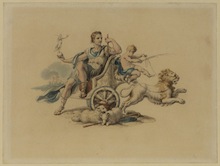
31 most dreadful thing; for there is not a more fearful
32 wild-fowl than your lion living; and we ought to
33 look to 't.
SNOUT
34 Therefore another prologue must tell he is not a
35 lion.
BOTTOM
36 Nay, you must name his name, and half his face
37 must be seen through the lion's neck: and he
38 himself must speak through, saying thus, or to the
39. defect: Bottom's blunder for effect.
39 same defect,—"Ladies,"—or "Fair-ladies—I would
40 You,"—wish or "I would request you,"—or "I
41-42. my life for yours: I pledge my life in defense of yours.
41 would entreat you,—not to fear, not to tremble: my
42 life for yours. If you think I come hither as a lion,
43. were pity of my life: would endanger my life.
43 it were pity of my life: no I am no such thing; I
44 am a man as other men are;" and there indeed let him
45 name his name, and tell them plainly he is Snug the
46 joiner.
QUINCE
|
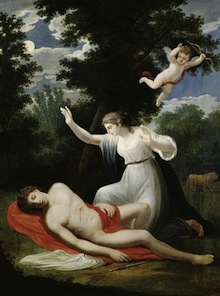
47 Well it shall be so. But there is two hard things;
48 that is, to bring the moonlight into a chamber;
49 for, you know, Pyramus and Thisby meet by
50 moonlight.
SNOUT
51 Doth the moon shine that night we play our
52 play?
BOTTOM
53 A calendar, a calendar! look in the almanac; find
54 out moonshine, find out moonshine.
QUINCE
55 Yes, it doth shine that night.
BOTTOM
56 Why, then may you leave a casement of the great
57 chamber window, where we play, open, and the moon
58 may shine in at the casement.
QUINCE
59. bush of thorns: Peasants saw "the man in the moon" as bearing a bundle of sticks. lanthorn: lantern. 60. disfigure: Quince's blunder for prefigure. 61. present: represent.
59 Ay; or else one must come in with a bush of thorns
60 and a lanthorn, and say he comes to disfigure, or to
61 present, the person of Moonshine. Then, there is
62 another thing: we must have a wall in the great
63 chamber; for Pyramus and Thisby says the story,
64 did talk through the chink of a wall.
SNOUT
65 You can never bring in a wall. What say you,
66 Bottom?
BOTTOM
67 Some man or other must present Wall: and let him
68. rough-cast: plaster mixed with pebbles for coating the outside of buildings.
68 have some plaster, or some loam, or some rough-cast
69 about him, to signify wall; and let him hold his
70 fingers thus, and through that cranny shall Pyramus
71 and Thisby whisper.
QUINCE
72 If that may be, then all is well. Come, sit down,
73 every mother's son, and rehearse your parts.
74 Pyramus, you begin: when you have spoken your
75 speech, enter into that brake: and so every one
76 according to his cue.
Enter ROBIN [PUCK, behind].
PUCK
77. hempen home-spuns: uncouth rustics (literally, persons wearing home-spun cloth made of hemp). swagg'ring: blustering about. 79. toward: about to take place.
77 What hempen home-spuns have we swagg'ring here,
78 So near the cradle of the fairy queen?
79 What, a play toward! I'll be an auditor;
80 An actor too, perhaps, if I see cause.
QUINCE
81 Speak, Pyramus. Thisby, stand forth.
BOTTOM
82. odious: blunder for odorous. Dogberry makes the reverse error in
Much Ado, III.v.16: "Comparisons are odorous."
82 "Thisby, the flowers of odious savours sweet,—
QUINCE
83 Odours, odours.
BOTTOM
84 —"odours savours sweet"—
85 So hath thy breath, my dearest Thisby dear.
86 But hark, a voice! stay thou but here awhile,
87 And by and by I will to thee appear."
Exit.
PUCK
88. here: i.e., here in this theatre or here on earth (?).
88 A stranger Pyramus than e'er played here.
[Exit.]
FLUTE
89 Must I speak now?
QUINCE
90 Ay, marry, must you; for you must understand
91 he goes but to see a noise that he heard, and is to
92 come again.
FLUTE
93 "Most radiant Pyramus, most lily-white of hue,
94 Of color like the red rose on triumphant brier,
95. brisky juvenal: lively youth. eke: also. Jew: Probably suggested by the first syllable of juvenal and used to provide a rhyme.
95 Most brisky juvenal and eke most lovely Jew,
96 As true as truest horse that yet would never tire,
97 I'll meet thee, Pyramus, at Ninny's tomb."
QUINCE
98. Ninus: mythical founder of Nineveh; his wife, Semiramis. reputedly erected Babylon, the location of the story of Pyramus and Thisbe.
98 "Ninus' tomb," man: why, you must not speak that
99 yet; that you answer to Pyramus: you speak all your
100 part at once, cues and all. Pyramus enter: your cue
|

103. fair: handsome. were: would be.
106. about a round: roundabout.
101 is past; it is, "never tire."
FLUTE
102 O,—"As true as truest horse, that yet would never tire."
[Enter PUCK, and BOTTOM with an ass's head.]
BOTTOM
103 "If I were fair, Thisby, I were only thine."
QUINCE
104 O monstrous! O strange! we are haunted. Pray,
105 masters! fly, masters! Help!
[Exeunt QUINCE, SNUG, FLUTE, SNOUT,
and STARVELING.]
PUCK
106 I'll follow you, I'll lead you about a round,
107 Through bog, through bush, through brake, through brier:
108 Sometime a horse I'll be, sometime a hound,
109. fire: will-o'-the-wisp —atmospheric ghost light fig. a thing (rarely a person) that deludes or misleads by means of fugitive appearances.
109 A hog, a headless bear, sometime a fire;
110 And neigh, and bark, and grunt, and roar, and burn,
111 Like horse, hound, hog, bear, fire, at every turn.
Exit.
116-117. an ass-head of your own: i.e., something dreamed up inside your own asinine head.
BOTTOM
112 Why do they run away? this is a knavery of them
113 to make me afeard.
Enter SNOUT.
SNOUT
114 O Bottom, thou art changed! what do I see on
115 thee?
BOTTOM
116 What do you see? you see an asshead of your
117 own, do you?
[Exit SNOUT.]
Enter QUINCE.
QUINCE
118 Bless thee, Bottom! bless thee! thou art
119. translated: transformed.
119 translated.
Exit.
BOTTOM
120 I see their knavery: this is to make an ass of me;
121 to fright me, if they could. But I will not stir
122 from this place, do what they can: I will walk up
123 and down here, and I will sing, that they shall hear
124 I am not afraid.
[Sings.]
125. woosel cock: male ousel or ouzel, blackbird.
125 The woosel cock so black of hue,
126 With orange-tawny bill,
127. throstle: song thrush.
127 The throstle with his note so true,
|
135. give a bird the lie: call a bird a liar.
136. never so: i.e., ever so much, continually.
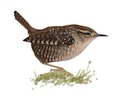
128 The wren with little quill,—
TITANIA [Awaking.]
129 What angel wakes me from my flowery bed?
BOTTOM [Sings.]
130 The finch, the sparrow and the lark,
131 The plain-song cuckoo gray,
132 Whose note full many a man doth mark,
133 And dares not answer nay;—
134 for, indeed, who would set his wit to so foolish
135 a bird? who would give a bird the lie, though he cry
136 "cuckoo" never so?
TITANIA
137 I pray thee, gentle mortal, sing again:
138 Mine ear is much enamour'd of thy note;
139 So is mine eye enthralled to thy shape;
140. thy fair virtue's force: the power of your beauty.
140 And thy fair virtue's force perforce doth move me
141 On the first view to say, to swear, I love thee.
BOTTOM
142 Methinks, mistress, you should have little reason
143-144. to say the truth, reason / and love keep little company together now-a-days: Once again Shakespeare's clown cuts staight to the truth of the matter. 145. the more the pity: expresses regret about a fact just stated. 146. gleek: scoff, gibe, jest.
143 for that: and yet, to say the truth, reason
144 and love keep little company together now-a-days;
145 the more the pity that some honest neighbours will
146 not make them friends. Nay, I can gleek upon
147 occasion.
TITANIA
148 Thou art as wise as thou art beautiful.
BOTTOM
149 Not so, neither: but if I had wit enough to get
150-151. serve mine / own turn: answer my purpose.
150 out of this wood, I have enough to serve mine
151 own turn.
TITANIA
152 Out of this wood do not desire to go:
153 Thou shalt remain here, whether thou wilt or no.
154. rate: value, worth.
154 I am a spirit of no common rate;
155. still: ever, always. doth tend upon my state: serves me, as part of my royal retinue.
155 The summer still doth tend upon my state;
156 And I do love thee: therefore, go with me;
157 I'll give thee fairies to attend on thee,
158 And they shall fetch thee jewels from the deep,
159 And sing while thou on pressed flowers dost sleep;
160. grossness: corporeal nature.
160 And I will purge thy mortal grossness so
161 That thou shalt like an airy spirit go.
162. Moth: Pronounced mote or mot . . . more
162 Peaseblossom! Cobweb! Moth! and Mustardseed!
|
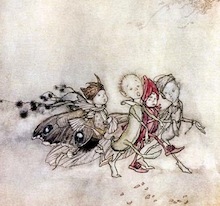
Enter four Fairies [PEASEBLOSSOM, COBWEB,
MOTH, and MUSTARDSEED].
PEASEBLOSSOM
163 Ready.
COBWEB
163 And I.
MOTH
163 And I.
MUSTARDSEED
163 And I.
ALL
163 Where shall we go?
TITANIA
164 Be kind and courteous to this gentleman;
165 Hop in his walks and gambol in his eyes;
166. apricocks: apricots.
166 Feed him with apricocks and dewberries,
167 With purple grapes, green figs, and mulberries;
168 The honey-bags steal from the humble-bees,
169 And for night-tapers crop their waxen thighs
170 And light them at the fiery glow-worm's eyes,
171. have: i.e., attend (with lights).
171 To have my love to bed and to arise;
172 And pluck the wings from Painted butterflies
173 To fan the moonbeams from his sleeping eyes:
174 Nod to him, elves, and do him courtesies.
PEASEBLOSSOM
175 Hail, mortal!
COBWEB
176 Hail!
MOTH
177 Hail!
MUSTARDSEED
178 Hail!
BOTTOM
179. cry your worship's mercy: beg pardon of your honors.
179 I cry your worship's mercy, heartily: I beseech your
180 worship's name.
COBWEB
181 Cobweb.
BOTTOM
182. of more acquaintance: to be better acquainted with me. 183-184. If I cut my finger, I shall make bold with you: Cobwebs were applied to cuts to inhibit bleeding.
182 I shall desire you of more acquaintance, good Master
183 Cobweb: if I cut my finger, I shall make bold with
184 you. Your name, honest gentleman?
PEASEBLOSSOM
185 Peaseblossom.
BOTTOM
186. commend me: give my regards. Squash: unripe pea pod. 187. Peascod: mature pea pod.
186 I pray you, commend me to Mistress Squash, your
187 mother, and to Master Peascod, your father. Good
188 Master Peaseblossom, I shall desire you of more
189 acquaintance too. Your name, I beseech you, sir?
MUSTARDSEED
190 Mustardseed.
BOTTOM
191 Good Master Mustardseed, I know your patience
192. patience: calmness in suffering.
192 well: that same cowardly, giant-like ox-beef hath
193 devoured many a gentleman of your house: I promise
194 you your kindred had made my eyes water ere now.
195 I desire your more acquaintance, good Master
196 Mustardseed.
TITANIA
197 Come, wait upon him; lead him to my bower.
198 The moon methinks looks with a watery eye;
199. she weeps: i.e., she causes dew.
199 And when she weeps, weeps every little flower,
200. enforced: forced, violated; or, possibly, constrained (since Titania at this moment is hardly concerned about chastity).
200 Lamenting some enforced chastity.
201 Tie up my love's tongue, bring him silently.
Exeunt.