The Taming of the Shrew: Act 1, Scene 1
Enter LUCENTIO and his man
TRANIO.
LUCENTIO
1 Tranio, since for the great desire I had2. nursery of arts: Padua's university was and still is one of the most prestigious in Europe. 3. am arriv'd for: have come here on my way to (?). fruitful: fertile.
2 To see fair Padua, nursery of arts,
3 I am arriv'd for fruitful Lombardy,
4 The pleasant garden of great Italy;
5 And by my father's love and leave am arm'd
6 With his good will and thy good company,
7. approv'd: tested and proved dependable.
7 My trusty servant, well approv'd in all,
8. breathe: pause for breath, i.e., remain for a time. haply: by good chance; i.e., because we now have the opportunity. institute: embark upon. 9. ingenious: intellectual.
8 Here let us breathe and haply institute
9 A course of learning and ingenious studies.
10 Pisa renown'd for grave citizens
11. first: i.e., before me.
11 Gave me my being and my father first,
12. traffic: business.
12 A merchant of great traffic through the world,
13 Vincetino come of Bentivolii.
14 Vincetino's son brought up in Florence
15. become: befit. to serve all hopes conceiv'd: i.e., to fulfill all hopes that his friends and family have for him. 16. deck: adorn.
15 It shall become to serve all hopes conceiv'd,
16 To deck his fortune with his virtuous deeds:
17 And therefore, Tranio, for the time I study
18 Virtue and that part of philosophy
19. apply: study. treats of: concerns.
19 Will I apply that treats of happiness
20 By virtue specially to be achieved.
21 Tell me thy mind; for I have Pisa left
22 And am to Padua come, as he that leaves
23. plash: pool.
23 A shallow plash to plunge him in the deep
24 And with satiety seeks to quench his thirst.
TRANIO
25. Mi perdonato: pardon me [Italian]. gentle: gentlemanly.
26. affected: disposed.
26. affected: disposed.
25 Mi perdonato, gentle master mine,
26 I am in all affected as yourself;
27 Glad that you thus continue your resolve
28 To suck the sweets of sweet philosophy.
29 Only, good master, while we do admire
30 This virtue and this moral discipline,
31. stocks: i.e., mere blocks of wood.
31 Let's be no stoics nor no stocks, I pray;
32. devote: devoted. checks: restraints.
32 Or so devote to Aristotle's checks
33. As: so that. Ovid: the Latin love-poet . . . more.
34. Balk logic: i.e., bandy arguments.
34. Balk logic: i.e., bandy arguments.
33 As Ovid be an outcast quite abjured.
34 Balk logic with acquaintance that you have
35 And practise rhetoric in your common talk;
36. quicken: stimulate, enliven.
36 Music and poesy use to quicken you;
37 The mathematics and the metaphysics,
38. Fall to: partake of. stomach: appetite, inclination.
38 Fall to them as you find your stomach serves you;
39 No profit grows where is no pleasure ta'en:
40. affect: find pleasing.
40 In brief, sir, study what you most affect.
LUCENTIO
41. Gramercies: many thanks.
41 Gramercies, Tranio, well dost thou advise.
42. Biondello: Biondello, Lucentio's other servant, is not present at the moment. Perhaps he stayed behind to handle the luggage.
42 If, Biondello, thou wert come ashore,
43 We could at once put us in readiness,
44 And take a lodging fit to entertain
45 Such friends as time in Padua shall beget.
46 But stay a while: what company is this?
TRANIO
47 Master, some show to welcome us to town.
Enter BAPTISTA with his two
daughters, KATHARINA and BIANCA,
pantaloon: i.e., a foolish, rich, lecherous, old man, like the commedia dell'arte character Pantalone.
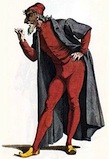 | Pantalone |
GREMIO, a pantaloon, HORTENSIO,
[suitor] to Bianca. LUCENTIO,
TRANIO stand by.
BAPTISTA
48 Gentlemen, importune me no farther,
49 For how I firmly am resolved you know;
50 That is, not bestow my youngest daughter
51 Before I have a husband for the elder:
52 If either of you both love Katharina,
53 Because I know you well and love you well,
54 Leave shall you have to court her at your pleasure.
GREMIO
55. cart: Carting—being paraded through the streets in a cart—was a slut-shaming punishment.
55 To cart her rather: she's too rough for me.
56 There, There, Hortensio, will you any wife?
KATHARINA
57 I pray you, sir, is it your will
58. stale: decoy. mates: rude louts (but Hortensio takes the word in the sense of "husbands").
58 To make a stale of me amongst these mates?
HORTENSIO
59 Mates, maid! how mean you that? no mates for you,
60 Unless you were of gentler, milder mold.
KATHARINA
61 I'faith, sir, you shall never need to fear:
62. I wis: indeed. it: i.e., marriage. 62‑63. her . . . her: Katharina is speaking of herself in the third person.
62 I wis it is not half way to her heart;
63 But if it were, doubt not her care should be
64. noddle: noodle, head.
64 To comb your noddle with a three-legg'd stool
65 And paint your face and use you like a fool.
HORTENSIO
66 From all such devils, good Lord deliver us!
GREMIO
67 And me too, good Lord!
TRANIO
68. Husht: Hush. toward: developing.
68 Husht, master! here's some good pastime toward:
69. wonderful froward: astoundingly headstrong.
69 That wench is stark mad or wonderful froward.
LUCENTIO
70 But in the other's silence do I see
71 Maid's mild behavior and sobriety.
71. Peace, Tranio!: Quiet, Tranio!
72 Peace, Tranio!
TRANIO
73 Well said, master; mum! and gaze your fill.
BAPTISTA
74 Gentlemen, that I may soon make good
75 What I have said, Bianca, get you in:
76 And let it not displease thee, good Bianca,
77 For I will love thee ne'er the less, my girl.
KATHARINA
78. peat: pet, spoiled darling.
78 A pretty peat! it is best
79. Put finger in the eye: i.e., make a big show of crying by poking one's own eye. an: if.
79 Put finger in the eye, an she knew why.
BIANCA
79. content you in my discontent: i.e., be happy that I am unhappy.
80 Sister, content you in my discontent.
81 Sir, to your pleasure humbly I subscribe:
82 My books and instruments shall be my company,
83 On them to took and practise by myself.
LUCENTIO
84. Minerva: goddess of wisdom.
84 Hark, Tranio! thou may'st hear Minerva speak.
HORTENSIO
85. so strange: i.e., so unnatural a father.
85 Signior Baptista, will you be so strange?
86. Sorry am I that our good will effects Bianca's grief: i.e., I'm sorry that our good intentions have resulted in Bianca's grief.
86 Sorry am I that our good will effects
87 Bianca's grief.
GREMIO
87. mew her up: shut her up; isolate her.
87 Why will you mew her up,
88. for this fiend of hell: i.e., rather than Katharina.
88 Signior Baptista, for this fiend of hell,
89. her . . . her: i.e., Bianca . . . Katherina's.
89 And make her bear the penance of her tongue?
BAPTISTA
90 Gentlemen, content ye; I am resolved:
91 Go in, Bianca:
Exit BIANCA.
92. for: because.
92 And for I know she taketh most delight
93 In music, instruments and poetry,
94 Schoolmasters will I keep within my house,
95 Fit to instruct her youth. If you, Hortensio,
96 Or Signior Gremio, you, know any such,
97. Prefer: recommend. cunning: skillful, able.
97 Prefer them hither; for to cunning men
98 I will be very kind, and liberal
99 To mine own children in good bringing up:
100 And so farewell. Katharina, you may stay;
101. commune: talk over.
101 For I have more to commune with Bianca.
Exit.
KATHARINA
102 Why, and I trust I may go too, may I not? What,
103 shall I be appointed hours; as though, belike, I
104 knew not what to take and what to leave, ha?
Exit.
GREMIO
105. dam: mother. 105‑106. your gifts ... hold you: i.e., you have so many wonderful qualities that no one here will hold you back from leaving as quickly as possible. 106. Their love: i.e., the love of women for men. 107. blow our nails: i.e., twiddle our thumbs. 108. fast it fairly out: i.e., pass our time doing without. 108‑109. our cake's dough on both sides: i.e., we're getting nowhere. 111-112. wish him to her father: recommend him to Baptista.
105 You may go to the devil's dam: your gifts are so
106 good, here's none will hold you. Their love is not
107 so great, Hortensio, but we may blow our nails
108 together, and fast it fairly out: our cake's dough on
109 both sides. Farewell: yet for the love I bear my
110 sweet Bianca, if I can by any means light on a fit
111 man to teach her that wherein she delights, I will
112 wish him to her father.
HORTENSIO
113 So will I, Signior Gremio: but a word, I pray.
114 Though the nature of our quarrel yet never
115. brook'd parle: allowed for a discussion of any compromise. upon advice: on second thought. toucheth: behooves, concerns.
115 brook'd parle, know now, upon advice, it toucheth
116 us both, that we may yet again have access to our fair
117 mistress and be happy rivals in Bianca's love, to
118 labor and effect one thing specially.
GREMIO
119 What's that, I pray?
HORTENSIO
120 Marry, sir, to get a husband for her sister.
GREMIO
121 A husband! a devil.
HORTENSIO
122 I say, a husband.
GREMIO
123 I say, a devil. Thinkest thou, Hortensio, though
124. so very a fool: such an absolute fool.
124 her father be very rich, any man is so very a fool
125 to be married to hell?
HORTENSIO
126. pass: exceeds.
126 Tush, Gremio, though it pass your patience and
127. alarums: i.e., screeches, curses, etc.
127 mine to endure her loud alarums, why, man, there
128-129. an a man could light on them: if a man could find them.
128 be good fellows in the world, an a man could light
129 on them, would take her with all faults, and money
130 enough.
GREMIO
131. I cannot tell: i.e., maybe you're right, but I doubt it.
132. high cross: crossroad? a cross set in a crossroad?
132. high cross: crossroad? a cross set in a crossroad?
131 I cannot tell; but I had as lief take her dowry with
132 this condition, to be whipped at the high cross
133 every morning.
HORTENSIO
134 Faith, as you say, there's small choice in rotten
135. bar in law: legal restriction; i.e., Baptista's "law" that Bianca cannot be married until Katharina has a husband.
135 apples. But come; since this bar in law makes us
136 friends, it shall be so far forth friendly
137 maintained till by helping Baptista's eldest daughter
138 to a husband we set his youngest free for a husband,
139-140. Happy man be his dole: i.e., may the man who marries Bianca be happy for life. 140. ring: prize, with play on "wedding ring."
139 and then have to't afresh. Sweet Bianca! Happy man
140 be his dole! He that runs fastest gets the ring.
141 How say you, Signior Gremio?
GREMIO
142 I am agreed; and would I had given him the best
143 horse in Padua to begin his wooing that would
144 thoroughly woo her, wed her and bed her and rid the
145 house of her! Come on.
stage direction.ambo: both.
Exeunt ambo [GREMIO and HORTENSIO].
stage direction.Manent: remain in place.
Manent Tranio and Lucentio.
TRANIO
146 I pray, sir, tell me, is it possible
147 That love should of a sudden take such hold?
LUCENTIO
148 O Tranio, till I found it to be true,
149 I never thought it possible or likely;
150 But see, while idly I stood looking on,
151. the effect of love in idleness: i.e., the magical love-inducing power the heartsease (pansy).
151 I found the effect of love in idleness:
152 And now in plainness do confess to thee,
153 That art to me as secret and as dear
154. Anna: the sister and confidante of Dido, Queen of Carthage, beloved of Aeneas.
154 As Anna to the queen of Carthage was,
155 Tranio, I burn, I pine, I perish, Tranio,
156 If I achieve not this young modest girl.
157 Counsel me, Tranio, for I know thou canst;
158 Assist me, Tranio, for I know thou wilt.
TRANIO
159 Master, it is no time to chide you now;
160. Affection is not rated from the heart: i.e., love cannot be driven away by scolding.
160 Affection is not rated from the heart:
161 If love have touch'd you, nought remains but so,
162. Redime te captum quam queas minimo: "Ransom yourself from captivity as cheaply as you can." . . . more.
162 "Redime te captum quam queas minimo."
LUCENTIO
163. contents: is satisfying.163 Gramercies, lad, go forward; this contents:
164 The rest will comfort, for thy counsel's sound.
TRANIO
165. look'd so longly on: i.e., spent so much of your time looking at. 166. pith: essence, gist.
165 Master, you look'd so longly on the maid,
166 Perhaps you mark'd not what's the pith of all.
LUCENTIO
167 O yes, I saw sweet beauty in her face,
168. daughter of Agenor: Europa, loved by Jupiter; he assumed the form of a bull to carry her off. 169. him: himself.
168 Such as the daughter of Agenor had,
169 That made great Jove to humble him to her hand.
170. strond: strand, shore.
170 When with his knees he kiss'd the Cretan strond.
TRANIO
171 Saw you no more? mark'd you not how her sister
172 Began to scold and raise up such a storm
173 That mortal ears might hardly endure the din?
LUCENTIO
174 Tranio, I saw her coral lips to move
175 And with her breath she did perfume the air:
176 Sacred and sweet was all I saw in her.
TRANIO
177 Nay, then, 'tis time to stir him from his trance.
178 I pray, awake, sir: if you love the maid,
179 Bend thoughts and wits to achieve her. Thus it stands:
180. curst and shrewd: The adjectives are synonyms, both meaning here "ill-natured, shrewish."
180 Her eldest sister is so curst and shrewd
181 That till the father rid his hands of her,
182 Master, your love must live a maid at home;
183. closely mew'd her up: placed her in close confinement (see line 87). 184. Because: so that.
183 And therefore has he closely mew'd her up,
184 Because she will not be annoy'd with suitors.
LUCENTIO
185 Ah, Tranio, what a cruel father's he!
186. advis'd: aware.
186 But art thou not advis'd, he took some care
187 To get her cunning schoolmasters to instruct her?
TRANIO
188 Ay, marry, am I, sir; and now 'tis plotted.
LUCENTIO
189 I have it, Tranio.
TRANIO
189. for: by. 189 Master, for my hand,
190. inventions: plans, schemes. jump: tally, agree.
190 Both our inventions meet and jump in one.
LUCENTIO
191 Tell me thine first.
TRANIO
191 You will be schoolmaster
192 And undertake the teaching of the maid:
193 That's your device.
LUCENTIO
193 It is: may it be done?
TRANIO
194 Not possible; for who shall bear your part,
195 And be in Padua here Vincentio's son,
196 Keep house and ply his book, welcome his friends,
197 Visit his countrymen and banquet them?
LUCENTIO
198. Basta: enough. [Italian.] full: i.e., fully planned.
198 Basta; content thee, for I have it full.
199 We have not yet been seen in any house,
200 Nor can we be distinguish'd by our faces
201 For man or master; then it follows thus;
202 Thou shalt be master, Tranio, in my stead,
203. port: state, style of living.
203 Keep house and port and servants as I should:
204 I will some other be, some Florentine,
205. meaner: of a lower social class.
205 Some Neapolitan, or meaner man of Pisa.
206 'Tis hatch'd and shall be so: Tranio, at once
207. Uncase: undress; i.e., remove hat and cloak. colour'd: In Shakespeare's time it was expected that the rich upper classes would dress more colorfully than their servants.
207 Uncase thee; take my colour'd hat and cloak:
[They begin to exchange clothes.]
208 When Biondello comes, he waits on thee;
209. charm: i.e., very strongly persuade. keep his tongue: keep quiet [about our scheme].
209 But I will charm him first to keep his tongue.
TRANIO
210. So had you need: i.e., Yes, you'd better do that. —Apparently Biondello is a blabbermouth. 211. sith: since.
210 So had you need.
211 In brief, sir, sith it your pleasure is,
212 And I am tied to be obedient;
213 For so your father charged me at our parting,
214. serviceable: diligent in service.
214 "Be serviceable to my son," quoth he,
215 Although I think 'twas in another sense;
216 I am content to be Lucentio,
217 Because so well I love Lucentio.
LUCENTIO
218 Tranio, be so, because Lucentio loves:
219 And let me be a slave, to achieve that maid
220. Whose sudden sight: i.e., the sudden sight of whom. thrall'd: captured, enthralled. wounded eye: —Lucentio's eye has been wounded by a dart of love shot from Cupid's bow.
220 Whose sudden sight hath thrall'd my wounded eye.
221 Here comes the rogue.
Enter BIONDELLO.
222 Sirrah, where have you been?
BIONDELLO
223 Where have I been! Nay, how now! where are you?
224 Master, has my fellow Tranio stolen your clothes? Or
225 you stolen his? or both? pray, what's the news?
LUCENTIO
226 Sirrah, come hither: 'tis no time to jest,
227 And therefore frame your manners to the time.
228 Your fellow Tranio here, to save my life,
229. count'nance: outward appearance.
229 Puts my apparel and my count'nance on,
230 And I for my escape have put on his;
231 For in a quarrel since I came ashore
232. descried: seen, identified.
232 I kill'd a man and fear I was descried:
233. as becomes: as is suitable.
233 Wait you on him, I charge you, as becomes,
234 While I make way from hence to save my life:
235 You understand me?
BIONDELLO
235. ne'er a whit: not even a little bit.
235 I, sir! ne'er a whit.
LUCENTIO
236 And not a jot of Tranio in your mouth:
237 Tranio is changed into Lucentio.
BIONDELLO
238 The better for him: would I were so too!
TRANIO
239 So could I, faith, boy, to have the next wish after,
240 That Lucentio indeed had Baptista's youngest daughter.
241 But, sirrah, not for my sake, but your master's, I advise
242 You use your manners discreetly in all kind of companies:
243 When I am alone, why, then I am Tranio;
244 But in all places else your master Lucentio.
LUCENTIO
245. rests: remains to be done.
245 Tranio, let's go: one thing more rests, that
246 thyself execute, to make one among these wooers: if
247. sufficeth: it suffices that.
247 thou ask me why, sufficeth, my reasons are both good
248 and weighty.
Exeunt.
[stage direction].Presenters: i.e. Sly and the servants of the lord who is playing the trick on Sly. A presenter is one who, by means of a prologue or an induction, introduces or presents a play to the spectators. above: i.e., seated in the balcony above the stage. 249. mind: pay attention to.
The Presenters above speak.
First Servant
249 My lord, you nod; you do not mind the play.
SLY
250 Yes, by Saint Anne, do I. A good matter, surely:
251 comes there any more of it?
Page
252 My lord, 'tis but begun.
SLY
253 'Tis a very excellent piece of work, madam lady:
254 would 'twere done!
[stage direction].mark: observe, pay attention to [the play].
They sit and mark.