The Merchant of Venice: Act 1, Scene 2
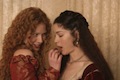
Enter PORTIA with her waiting-woman, NERISSA.
PORTIA
1 By my troth, Nerissa, my little body is aweary of
2 this great world.
NERISSA
3 You would be, sweet madam, if your miseries were in
4 the same abundance as your good fortunes are; and
5 yet, for aught I see, they are as sick that surfeit
6 with too much as they that starve with nothing. It
7‑8. in the mean: between the extremes of too little and too much. 8. comes sooner by: acquires sooner, gets.
7 is no mean happiness therefore, to be seated in the
8 mean: superfluity comes sooner by white hairs, but
9. competency: moderate means.
9 competency lives longer.
PORTIA
10. sentences: maxims.
10 Good sentences and well pronounced.
NERISSA
11 They would be better, if well followed.
PORTIA
12 If to do were as easy as to know what were good
13 to do, chapels had been churches and poor men's
14. divine: clergyman.
14 cottages princes' palaces. It is a good divine that
15. follows his own instructions: practices what he preaches.
15 follows his own instructions: I can easier teach
16 twenty what were good to be done, than be one of
17 the twenty to follow mine own teaching. The brain
18. for the blood: to control passion. Blood was thought of as a chief agent of the passions . . . more hot temper: impetuous temperament. 20‑21. meshes of good counsel the / cripple: nets, snares of wisdom: good counsel is portrayed as an old man incapable of action. 22. this reasoning is not in the fashion to choose me a husband: this line of reasoning is not the way to help me in choosing a husband. 24. will: desire, volition. 25. will: testament.
18 may devise laws for the blood, but a hot temper
19 leaps o'er a cold decree: such a hare is madness the
20 youth, to skip o'er the meshes of good counsel the
21 cripple. But this reasoning is not in the fashion to
22 choose me a husband. O me, the word 'choose!' I
23 may neither choose whom I would nor refuse whom
24 I dislike; so is the will of a living daughter curbed
25 by the will of a dead father. Is it not hard, Nerissa,
26 that I cannot choose one nor refuse none?
NERISSA
27 Your father was ever virtuous; and holy men at
28 their death have good inspirations: therefore the
29 lottery, that he hath devised in these three chests
30‑31. whereof: among which chests. who: whoever. chooses his meaning: i.e., guesses your father's intention correctly.
30 of gold, silver and lead, whereof who chooses his
31 meaning chooses you, will, no doubt, never be
32 chosen by any rightly but one who shall rightly
33 love. But what warmth is there in your affection
34 towards any of these princely suitors that are
35 already come?
PORTIA
36. over-name them: name them over.
36 I pray thee, over-name them; and as thou namest
37 them, I will describe them; and, according to my
38. level: aim, guess.
38 description, level at my affection.
NERISSA
39 First, there is the Neapolitan prince.
PORTIA
40. colt: — In Shakespeare's time Neapolitans were famous for horsemanship.
40 Ay, that's a colt indeed, for he doth nothing but
41 talk of his horse; and he makes it a great
42. appropriation: addition. good parts: accomplishments.
42 appropriation to his own good parts, that he can
43 shoe him himself. I am much afeard my lady his
44 mother played false with a smith.
NERISSA
45. County: Count. Palatine: one possessing royal privileges.
47. choose: i.e., do what you please.
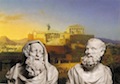
49. weeping philosopher: i.e., Heraclitus of Ephesus, a melancholic philosopher and Democritus . . . more 51‑52. death's-head with a bone in his mouth: Probably referring to the skull and cross-bones frequently cut on tombstones.
47. choose: i.e., do what you please.
49. weeping philosopher: i.e., Heraclitus of Ephesus, a melancholic philosopher and Democritus . . . more 51‑52. death's-head with a bone in his mouth: Probably referring to the skull and cross-bones frequently cut on tombstones.
45 Then there is the County Palatine.
PORTIA
46 He doth nothing but frown, as who should say
47 "If you will not have me, choose." He hears
48 merry tales and smiles not. I fear he will prove
49 the weeping philosopher when he grows old,
50 being so full of unmannerly sadness in his youth.
51 I had rather be married to a death's-head with a
52 bone in his mouth than to either of these. God
53 defend me from these two!
NERISSA
54. by: concerning.
54 How say you by the French lord, Monsieur
55 Le Bon? PORTIA
56 God made him, and therefore let him pass for a man.
57 In truth, I know it is a sin to be a mocker: but,
58 he! why, he hath a horse better than the
59 Neapolitan's, a better bad habit of frowning than
60 the Count Palatine; he is every man in no man; if a
61. throstle: thrush.
61 throstle sing, he falls straight a capering: he will
62 fence with his own shadow: if I should marry him, I
63 should marry twenty husbands. If he would despise
64 me, I would forgive him, for if he love me to madness,
65 I shall never requite him.
NERISSA
66 What say you, then, to Falconbridge, the young baron
67 of England?
PORTIA
68 You know I say nothing to him, for he understands
69 not me, nor I him: he hath neither Latin, French,
70 nor Italian, and you will come into the court and
71 swear that I have a poor pennyworth in the English.
72. is a proper man's picture: is handsome in appearance.
72 He is a proper man's picture, but, alas, who can
73 converse with a dumb-show? How oddly he is
74. suited: appareled, dressed. doublet: coat, upper garment.
74 suited! I think he bought his doublet in Italy, his
75. round hose: short, tight-fitting breeches. bonnet: soft, cap-like hat. The satire in this passage on the international character of an English gallant's costume was commonplace at this time.
75 round hose in France, his bonnet in Germany
76 and his behavior every where.
NERISSA
77 What think you of the Scottish lord, his
78 neighbor?
PORTIA
79 That he hath a neighborly charity in him, for he
80 borrowed a box of the ear of the Englishman and
81 swore he would pay him again when he was able.
82‑83. became his surety and sealed under for another: guaranteed the Scot's payment (of a box on the ear) and pledged himself to pay the Englishman with another blow (an allusion to French promises to back the Scots in their quarrels with the English).
82 I think the Frenchman became his surety and sealed
83 under for another.
NERISSA
84 How like you the young German, the Duke of
85 Saxony's nephew?
PORTIA
86 Very vilely in the morning, when he is sober, and
87 most vilely in the afternoon, when he is drunk: when
88 he is best, he is a little worse than a man, and
89 when he is worst, he is little better than a beast:
90. fall: befall. fell: befell.
90 and the worst fall that ever fell, I hope I shall
91. make shift: manage, contrive.
91 make shift to go without him.
NERISSA
92 If he should offer to choose, and choose the right
93 casket, you should refuse to perform your father's
94 will, if you should refuse to accept him.
PORTIA
95 Therefore, for fear of the worst, I pray thee, set a
96. rhenish wine: a German white wine from the Rhine valley. contrary: wrong.
96 deep glass of rhenish wine on the contrary casket,
97 for if the devil be within and that temptation
98 without, I know he will choose it. I will do any
99 thing, Nerissa, ere I'll be married to a sponge.
NERISSA
100 You need not fear, lady, the having any of these
101 lords: they have acquainted me with their
102 determinations; which is, indeed, to return to their
103 home and to trouble you with no more suit, unless
104. sort: manner, way.
104 you may be won by some other sort than your father's
105. imposition: conditions imposed (if they fail to choose the right casket); see II.i.38‑42.
105 imposition depending on the caskets.
PORTIA
106. Sibylla: the Cumaean Sibyl. Apollo promised her that her years would equal the number of grains of sand she held in her hand.
106 If I live to be as old as Sibylla, I will die as
107 chaste as Diana, unless I be obtained by the manner
108 of my father's will. I am glad this parcel of wooers
109 are so reasonable, for there is not one among them
110 but I dote on his very absence, and I pray God grant
111 them a fair departure.
NERISSA
112 Do you not remember, lady, in your father's time, a
113 Venetian, a scholar and a soldier, that came hither
114 in company of the Marquis of Montferrat?
PORTIA
115 Yes, yes, it was Bassanio — as I think, he was so
116 called.
NERISSA
117 True, madam: he, of all the men that ever my
118 foolish eyes looked upon, was the best deserving
119 a fair lady.
PORTIA
120 I remember him well, and I remember him worthy
121 of thy praise.
Enter a SERVINGMAN.
122 How now! what news?
Servant
123. four: Nerissa has actually named six suitors, possibly a sign of revision. strangers: foreigners.
123 The four strangers seek for you, madam, to take
124 their leave: and there is a forerunner come from a
125 fifth, the Prince of Morocco, who brings word the
126 prince his master will be here tonight.
PORTIA
127 If I could bid the fifth welcome with so good a
128 heart as I can bid the other four farewell, I should
129. condition: disposition, character.
129 be glad of his approach: if he have the condition
130. complexion of a devil: Devils were always represented as black in Shakespeare's day. 131. shrive me: act as my confessor; and grant me absolution. 132. Sirrah: form of address used on inferiors.
130 of a saint and the complexion of a devil, I had
131 rather he should shrive me than wive me.
132 Come, Nerissa. Sirrah, go before.
133 Whiles we shut the gates upon one wooer,
133 another knocks at the door.
Exeunt.